

Understanding HVAC Installation Cost: Your Comprehensive Guide to Budgeting a New System (Including 2,000 Sq Ft Homes)
Navigate the complexities of new HVAC system expenses, from initial estimates to long-term savings, ensuring smart climate control for your home.
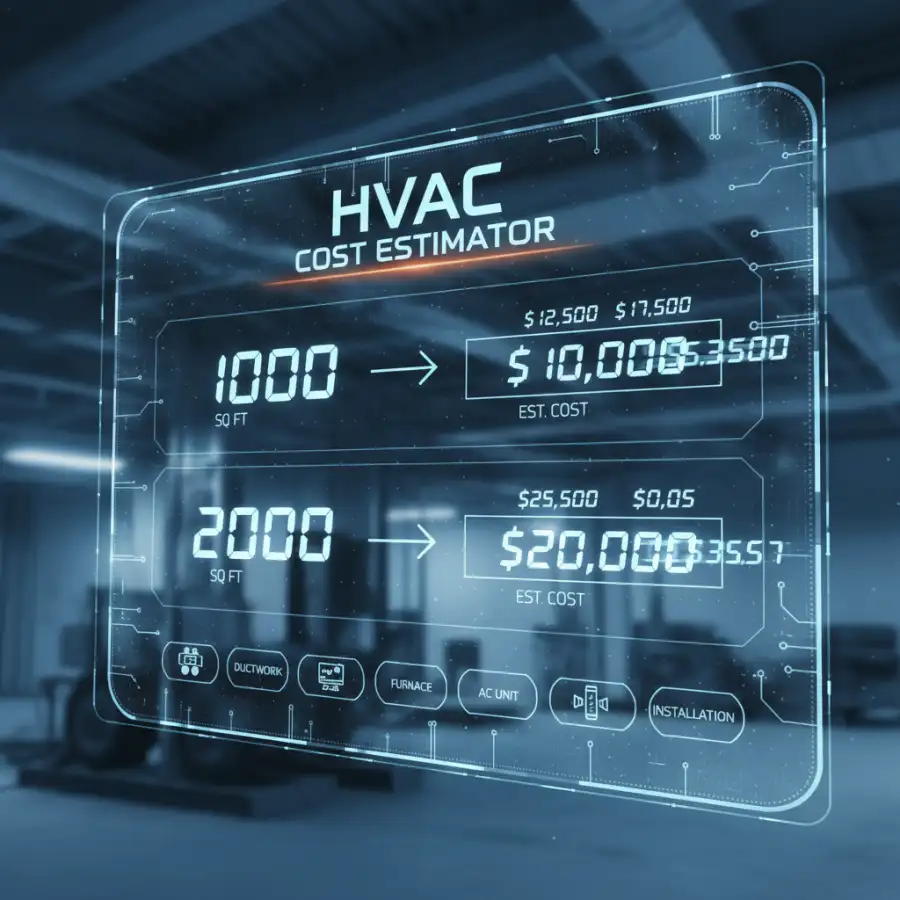
Facing a failing furnace or an aging air conditioner? The thought of a new HVAC system cost can be daunting, but it's an investment in your home's comfort and value.
From unexpected breakdowns to planned upgrades, understanding the financial landscape of HVAC installation is crucial for making a smart decision.
Don't let guesswork dictate your budget. This guide breaks down every factor, helping you accurately estimate the expense of a new system, especially for a 2,000 sq ft home.
A well-functioning HVAC (Heating, Ventilation, and Air Conditioning) system is the silent guardian of your home's comfort, health, and energy efficiency. Yet, when it comes time for replacement or a brand-new installation, the question of "What is the HVAC installation cost?" quickly becomes a primary concern. The answer, however, is rarely simple, varying widely based on numerous factors unique to each home and system. This comprehensive guide aims to demystify the expenses associated with a new HVAC system, providing a clear breakdown of influencing factors, typical costs by system type and home size (with a specific focus on a 2,000 sq ft house), and essential tools for estimating your project budget. Our goal is to equip you with the knowledge needed to make a well-informed purchasing decision, ensuring your home remains comfortable and efficient for years to come without unexpected financial surprises.
Quick navigation
Why HVAC Matters: Beyond Just Temperature Control
While often taken for granted until a problem arises, your HVAC system plays a far more critical role in your home than simply heating and cooling. Its impact extends to comfort, health, and your wallet.
Maintaining Optimal Indoor Comfort
The most obvious benefit of a functional HVAC system is its ability to maintain a consistent, comfortable temperature throughout your home, regardless of outside conditions. This isn't just about avoiding extreme heat or cold; it's about humidity control, consistent airflow, and ensuring every room feels pleasant. A properly sized and installed system eliminates hot and cold spots, making your living spaces genuinely enjoyable. Can you truly put a price on returning home to perfect climate control?
Impact on Indoor Air Quality and Health
Modern HVAC systems, especially those with advanced filtration, significantly improve indoor air quality. They filter out dust, allergens, pet dander, mold spores, and other pollutants, which is crucial for occupants with allergies, asthma, or respiratory sensitivities. Proper ventilation also prevents the buildup of stale air and volatile organic compounds (VOCs). Investing in a good HVAC system is investing in the health of your family. Is clean, fresh air a priority for your home?
Energy Efficiency and Long-Term Savings
Newer HVAC systems boast significantly higher Seasonal Energy Efficiency Ratio (SEER) for air conditioners and Annual Fuel Utilization Efficiency (AFUE) for furnaces. These higher ratings mean less energy consumption to achieve the same heating or cooling, translating into substantial monthly savings on your utility bills. Over the lifespan of a system, these savings often offset a significant portion of the initial HVAC installation cost. For homeowners also looking at other energy-efficient upgrades, understanding aspects like eco-friendly roofing can provide a holistic view of home efficiency.
Preserving Home Value and Structural Integrity
An efficient HVAC system contributes to a home's overall value and can even help preserve its structural integrity by controlling humidity, which prevents mold growth and wood rot. It's a key selling point for potential buyers, often ranked high on a list of desirable home features. A well-maintained system signals a well-maintained home. Do you view your HVAC as a critical component of your home's long-term health?
More Than Just Temperature: Your HVAC system is the unsung hero of your home. It's an intricate network ensuring your comfort, safeguarding your health, and protecting your investment for years to come.
Deconstructing the HVAC Installation Cost: Key Factors at Play
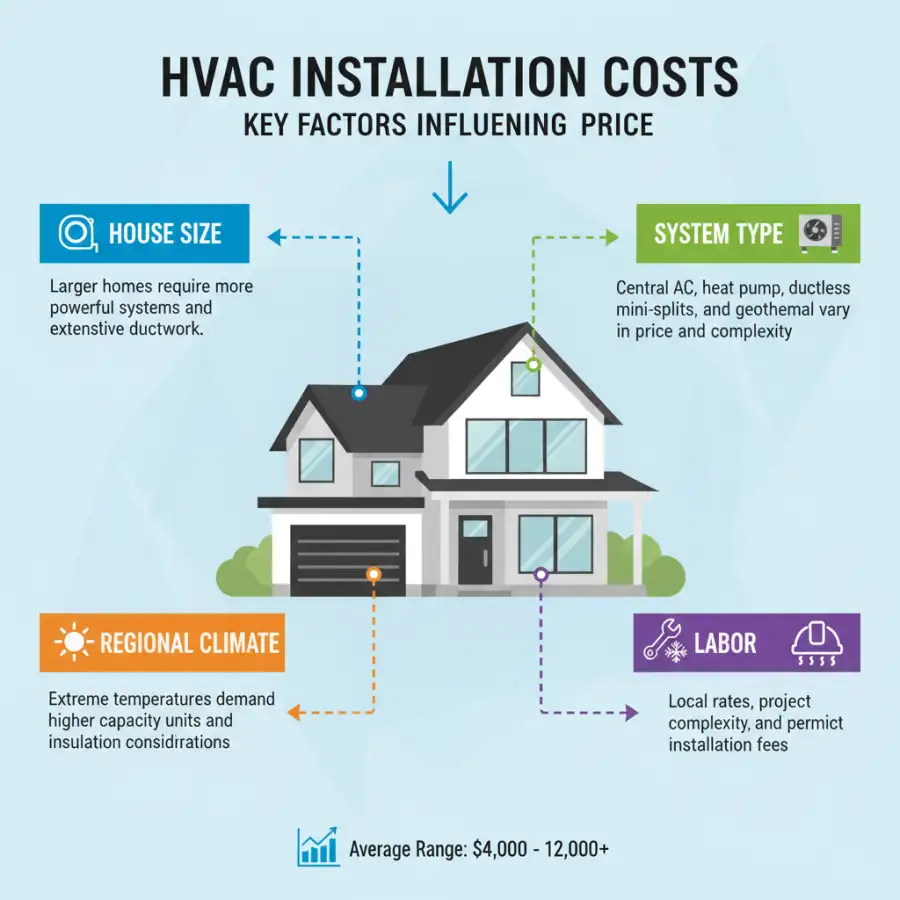
The total HVAC installation cost is a composite of several variables, each contributing significantly to the final price tag. Understanding these factors is the first step toward accurate budgeting.
System Type and Efficiency Ratings (SEER, AFUE)
The most impactful factor is the type of system you choose (e.g., central AC, furnace, heat pump, mini-split), which we'll explore in detail below. Within each type, efficiency ratings play a crucial role. Higher SEER (for AC) and AFUE (for furnaces) ratings mean greater energy efficiency but also a higher upfront cost for the unit itself. While a 14 SEER unit is typically the minimum, a 20+ SEER unit will cost more initially but save more on energy bills over its lifetime. Is maximizing long-term energy savings your priority, or is the upfront cost more critical?
System Size (BTUs/Ton)
HVAC systems are sized in British Thermal Units (BTUs) for heating and tons for cooling (1 ton = 12,000 BTUs). The correct size is critical for efficiency and comfort. An undersized system will run constantly, struggling to heat or cool, while an oversized system will cycle on and off too frequently (short-cycling), leading to inefficiency and premature wear. Proper sizing requires a Manual J load calculation, which considers factors like square footage, insulation, window efficiency, and climate. Is your contractor performing a thorough load calculation?
Ductwork Condition and Modification
For central systems, existing ductwork is a major factor. If your current ducts are old, leaky, poorly sized, or non-existent (e.g., converting from radiant heat to forced air), significant repairs, sealing, or entirely new duct installation will add considerably to the cost. Ductwork can represent 10-20% of the total installation cost, sometimes more for extensive overhauls. What condition is your current ductwork in?
Labor Costs and Regional Variations
Labor typically accounts for 30-50% of the HVAC installation cost. This includes the time for removing the old system, installing new units, connecting refrigerant lines and electrical, and testing. Labor rates vary significantly by geographic region, with higher costs in urban areas or regions with a higher cost of living. The complexity of the installation also impacts labor hours. Are you getting quotes from multiple reputable contractors to compare labor rates?
Permits and Inspections
Most HVAC installations necessitate obtaining permits from local authorities. This crucial step ensures that all work complies with stringent building codes and essential safety standards, ultimately protecting you, your family, and your investment. While the cost of these permits varies by municipality, typically ranging from a few hundred dollars, it's a non-negotiable expense. Once the installation is complete, official inspections are conducted to verify that the work adheres to all regulations and is installed correctly. Never allow a contractor to bypass the permitting and inspection process. Doing so can lead to significant legal complications, potential safety hazards, difficulties with homeowners insurance, and even issues when you decide to sell your home. A reputable contractor will always include permit costs in their initial quote and handle the necessary paperwork.
Brand, Features, and Additional Components
Just like automobiles, HVAC systems are available from various brands, each with distinct reputations, technological advancements, and price points. Premium brands like Trane, Carrier, and Lennox often feature proprietary technologies, higher efficiency models, and extended warranties, reflecting their higher cost. More budget-friendly options from brands such as Goodman, Rheem, and York offer reliable performance at a lower upfront investment. Beyond the core unit, a host of additional components and features can significantly enhance your system's functionality and your home's comfort. Smart thermostats, for instance, offer precise control, learning capabilities, remote access via smartphone apps, and energy usage reports, optimizing efficiency. Zoning systems allow you to heat or cool different areas of your home independently, preventing energy waste in unused rooms and ensuring personalized comfort. Furthermore, air quality enhancements like UV lights for germicidal purification, advanced HEPA filters, or whole-home humidifiers/dehumidifiers can elevate indoor air quality to a healthier standard. While these additions increase the total installation cost, they often provide substantial benefits in terms of comfort, convenience, and long-term air quality.
Financing Options and Incentives
Beyond the sticker price, understanding your financing options and available incentives can drastically reduce the net cost of your HVAC installation. Many homeowners opt for dedicated HVAC financing plans offered by contractors, often with low or 0% APR for an introductory period. Alternatively, home equity loans or lines of credit can provide favorable interest rates for larger investments. Don't overlook federal tax credits (like the Inflation Reduction Act's credits for energy-efficient home improvements), state rebates, or local utility company incentives, which can offer significant savings. These programs are designed to encourage homeowners to upgrade to more efficient systems, effectively lowering your out-of-pocket expenses. Always inquire about these opportunities when getting quotes from contractors.
Beyond the Unit Price: The true cost of HVAC installation encompasses much more than just the equipment. Always ask for a detailed, itemized quote to understand where your money is going.
HVAC Costs by System Type: A Detailed Breakdown
The type of HVAC system you choose is the primary determinant of your overall installation cost. Here's a look at common systems and their typical price ranges:
Central Air Conditioning Unit (Replacement)
Cost Range: $3,800 - $7,500 (unit + installation)
This refers to a split system with an outdoor condenser unit and an indoor evaporator coil that works with your existing furnace. Costs vary by SEER rating, brand, and size (in tons). A higher SEER will cost more upfront but save more on energy. Replacement typically costs less than a full new installation if ductwork is already in place.
Furnace (Gas or Electric) (Replacement)
Cost Range: $3,000 - $7,000 (unit + installation)
Furnaces are the workhorse of heating in many homes. Gas furnaces are often more expensive to install but cheaper to operate than electric models, depending on local utility costs. AFUE ratings determine efficiency, with higher AFUE leading to higher initial costs but greater fuel savings. Conversion from electric to gas, or vice-versa, can add significant costs for new gas lines or electrical upgrades.
Heat Pump (Split or Packaged) (Replacement)
Cost Range: $4,000 - $9,000 (unit + installation)
Heat pumps provide both heating and cooling by moving heat rather than generating it. They are highly energy-efficient in moderate climates. Costs depend on size, SEER (cooling) and HSPF (Heating Seasonal Performance Factor) ratings, and whether it's a split system (like central AC) or a packaged unit (all components in one outdoor cabinet). They can be a significant upgrade for homes currently using separate furnace and AC units.
Ductless Mini-Split Systems (Installation)
Cost Range: $2,000 - $6,000 per zone (unit + installation)
Ideal for homes without existing ductwork, additions, or for zoning specific areas. Each indoor unit (head) provides heating and cooling for a single zone, connected to an outdoor compressor. While more expensive per zone than central systems for an entire home, they offer incredible flexibility and efficiency for targeted areas. A multi-zone system for an entire 2,000 sq ft home could range from $8,000 to $20,000+ depending on the number of zones.
Geothermal Heat Pump System (Installation)
Cost Range: $18,000 - $45,000+ (system + installation)
Geothermal heat pump systems represent the pinnacle of energy efficiency and environmental responsibility, albeit with the highest upfront installation cost. These systems harness the stable temperature of the earth through a network of buried loops (either horizontal, vertical, or pond/lake loops, depending on property size and geology) to provide incredibly efficient heating and cooling. By exchanging heat with the ground, they achieve remarkably low operating costs, often reducing utility bills by 30-70% compared to conventional systems. While the extensive excavation required for loop installation is a significant factor in the initial expense, geothermal systems boast exceptional longevity (the ground loops can last 50+ years, and the indoor unit 20-25 years). Crucially, substantial federal tax credits (currently 30% for systems installed through 2032) and various state and local incentives can significantly offset this initial investment, making the long-term return on investment (ROI) highly attractive. For homeowners prioritizing sustainability, minimal environmental impact, and consistent, low-cost climate control for decades, geothermal is an unparalleled choice. Is an advanced, ultra-efficient system that offers substantial long-term savings and environmental benefits within your long-term vision?
Estimating Your HVAC Budget: Cost by Home Size
Home square footage is a primary driver for HVAC system sizing and, consequently, its installation cost. While a Manual J load calculation is essential for accuracy, general estimates by size can help you set an initial budget.
The Relationship Between Square Footage and System Size (BTUs/Ton)
As a rule of thumb, homes typically require about 20 BTUs of cooling per square foot. This translates to roughly 1 ton of cooling capacity for every 400-600 square feet. So, a 1,000 sq ft home might need a 2-2.5 ton AC, while a 3,000 sq ft home could need a 5-ton unit. Heating requirements also scale with size but are heavily influenced by climate and insulation. This is a crucial starting point for understanding how your home's footprint impacts the necessary HVAC unit size and subsequent cost.
HVAC Costs for a 2,000 Sq Ft Home
For a 2,000 sq ft home, you're generally looking at needing a 3.5 to 4-ton air conditioner and a furnace sized appropriately for your climate (often around 70,000-100,000 BTUs). The new HVAC system cost for a 2,000 sq ft home typically falls within the following ranges for a complete system replacement (furnace + AC or heat pump):
- Basic/Standard Efficiency (14-16 SEER, 80% AFUE): $6,000 - $10,000
- Mid-Range Efficiency (17-19 SEER, 90-95% AFUE): $9,000 - $14,000
- High-Efficiency/Premium (20+ SEER, 96%+ AFUE): $13,000 - $20,000+
These figures include both the equipment and standard installation labor, assuming existing ductwork is in good condition. If new ductwork is required, or if you're opting for a complex multi-zone mini-split system, these costs can increase significantly. Do these ranges align with your initial expectations?
Estimates for Other Home Sizes
- 1,000 - 1,500 Sq Ft Home: Expect to pay $4,500 - $9,000 for a standard central AC and furnace replacement (2-3 ton AC).
- 2,500 - 3,000 Sq Ft Home: Costs typically range from $8,000 - $16,000 for a standard central AC and furnace replacement (4-5 ton AC).
- 3,000+ Sq Ft Home: For larger homes, expect $15,000 - $25,000+ for a comprehensive central system, especially if zoning or multiple units are required.
These are broad estimates. Your actual cost will depend on the factors discussed previously: system type, brand, efficiency, regional labor rates, and specific installation challenges. Always obtain multiple detailed quotes from licensed professionals. Planning for major home expenses, such as a new HVAC system, often goes hand-in-hand with budgeting for other crucial components like a roof. Understanding the roof replacement cost per square can provide a valuable parallel for comparing and managing significant home improvement investments.
What this means for you
For you, the homeowner, understanding the intricate details of HVAC installation cost translates directly into smarter financial and home comfort decisions. This guide means you're no longer approaching a potential HVAC replacement with uncertainty; instead, you're equipped with comprehensive knowledge about what drives expenses, how different systems compare, and what to expect for your specific home size, such as a 2,000 sq ft property. It means you can confidently engage with contractors, ask informed questions, and scrutinize quotes, ensuring you get the most efficient, appropriately sized, and cost-effective system for your needs. This empowerment protects you from overpaying, helps you maximize energy savings, and ensures your home remains a haven of comfort and clean air for years to come. Your investment in HVAC is an investment in your quality of life, and now you have the tools to make it a wise one.
Risks, trade-offs, and blind spots
While investing in a new HVAC system is a wise decision, it's crucial to acknowledge the potential risks, inherent trade-offs, and common blind spots that homeowners often encounter during the process.
Incorrect System Sizing
One of the most significant risks is installing an improperly sized HVAC system. An undersized unit will struggle to heat or cool your home, leading to discomfort and constant running, wasting energy. An oversized unit will short-cycle, turning on and off too frequently, which also wastes energy, causes temperature swings, and dramatically shortens the system's lifespan. A blind spot is trusting a contractor who doesn't perform a proper Manual J load calculation and instead relies on rules of thumb. The trade-off for a quick estimate is years of inefficiency and discomfort. Has your contractor truly assessed your home's unique needs, or are they just guessing?
Choosing the Cheapest Option Over Value
While budgeting is important, opting for the absolute cheapest HVAC installation can be a major blind spot. This often means lower-quality equipment, less experienced installers, or cutting corners on critical components like ductwork. The initial savings are typically offset by higher energy bills, frequent repairs, and a shorter system lifespan. The trade-off for a lower upfront cost is higher long-term expenses and persistent headaches. Does the lowest bid truly represent the best value for your home, or simply the lowest price?
Neglecting Ductwork Inspection and Sealing
Even if you're replacing a perfectly good furnace and AC, faulty ductwork can sabotage the efficiency of your new system. Leaky ducts can lose up to 30% of your conditioned air before it even reaches your living spaces. A blind spot is focusing solely on the new unit and neglecting a thorough inspection and sealing of your existing ductwork. The trade-off of saving on ductwork upgrades can be a brand-new, high-efficiency system performing like an old, inefficient one. Has your contractor included a ductwork assessment in their proposal?
Inadequate Contractor Vetting
Hiring an unlicensed, uninsured, or inexperienced HVAC contractor is a significant risk. Poor installation quality can void warranties, create safety hazards, and lead to expensive repairs. A blind spot is not checking references, verifying licenses, or ensuring the contractor has adequate insurance. The trade-off for a quick or informal hire can be a disastrous, unfixable installation. Are you entrusting your home's comfort and safety to a truly qualified professional?
Overlooking Maintenance and Warranties
The HVAC installation cost doesn't end on installation day. A blind spot is neglecting to understand the system's maintenance requirements and warranty terms. Most manufacturers require annual professional maintenance to keep warranties valid. Without proper upkeep, even a high-efficiency system will perform poorly and fail prematurely. The trade-off of skipping maintenance is premature system failure and voided coverage. Do you have a plan for regular maintenance, and do you understand your warranty obligations?
How often should I replace my HVAC system?
Generally, furnaces last 15-20 years, and air conditioners/heat pumps last 10-15 years. However, if your system is over 10 years old and requiring frequent, costly repairs, or if your energy bills are unusually high, it's often more economical to replace it sooner rather than later.
Can I install HVAC myself to save money?
While some minor tasks can be DIY, full HVAC installation is highly complex and requires specialized skills, tools, and certifications (e.g., for handling refrigerants). Improper installation can void warranties, lead to inefficient operation, safety hazards, and potentially costly repairs. It is strongly recommended to hire licensed professionals.
Main points
Navigating the costs of a new HVAC system installation requires a comprehensive understanding of various factors. Here are the core takeaways to ensure you make a smart, informed decision:
- HVAC is Crucial: Beyond temperature, it impacts indoor air quality, energy efficiency, and home value. It's a foundational investment.
- Cost is Multifaceted: HVAC installation cost depends heavily on system type, efficiency (SEER/AFUE), correct sizing (BTUs/tons), ductwork condition, labor rates, permits, and additional features.
- System Type Matters: Central AC/Furnace, Heat Pumps, Ductless Mini-Splits, and Geothermal systems each have distinct price ranges and suitability for different needs.
- Square Footage Guides Sizing: For a new HVAC system cost for a 2,000 sq ft home, expect to pay between $6,000 and $20,000+ for a complete system, depending on efficiency and complexity.
- Prioritize Proper Sizing: Insist on a Manual J load calculation to prevent inefficient operation, discomfort, and premature system failure.
- Vet Your Contractor: Choose licensed, insured, and experienced professionals with strong reputations to ensure quality installation and valid warranties.
- Consider Long-Term Value: Balance upfront costs with long-term energy savings and overall system lifespan. Don't compromise quality for a slightly lower initial price.
By keeping these main points in mind, you can approach your HVAC installation with confidence, securing a system that provides optimal comfort, efficiency, and peace of mind for your home for many years to come. Your ideal climate is within reach!